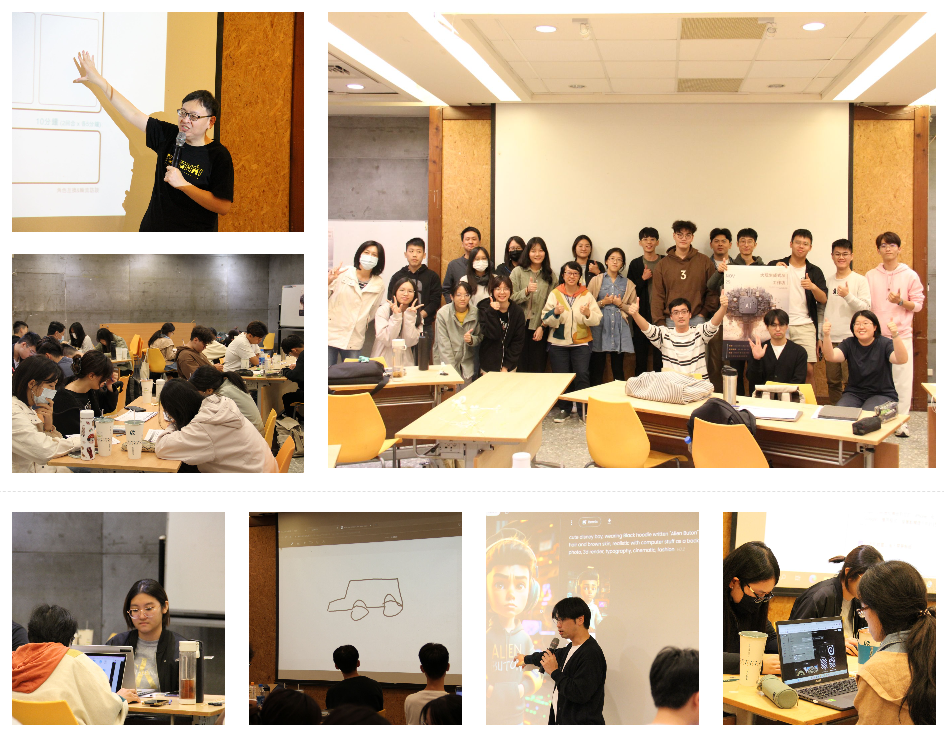
Generative AI is the buzzword of the year. In order to cultivate student’s ability to effectively utilize generative AI academically, Tunghai Univeristy’s XPlorer Project collaborate with Tunghai University Design-Thinking. Working together, to host the “Play with Generative AI Workshop” event on November 25th. Participants include students from various disciplines, such as department of Japanese language and culture, department of public management and policy, department of philosophy, department of business administration, department of social science, department of fiancé, department of information management, etc. A total of 25 students collectively engaged in envisioning the future classrooms and fine-tuning the course selection system.
Tunghai University Design-Think led a design thinking workshop that initiated a collective journey for the participants to think and explore possibilities together. The participants worked in pairs on design thinking. The empathy stage allowed participants to gain a deep understanding of each other’s needs and expectations for future classrooms and the course selection system. The participants discovered new perspectives from each other’s feelings and motivations, thought outside of the box and discovered potential need and opportunity through conversations. Participants sketched out designs according to a user-centric approach, based on need and expectations, shared the designs with each other, received feedback from their partner, and readjusted their designs accordingly.
Generative AI encompasses a diverse array of categories, His-An Hsieh, from Asia University explains the structure of prompt for generative AI. First, the sequence of keywords would influence the weighting; additionally the keywords can be stored according to themes (e.g. cars, toys…), style (e.g. streamline, soft…), material (e.g. white plastic, red electroplating…), rendering (e.g. illustration, realistic, 3D rendering…), photography method (e.g. front view, top view…). Providing a more precise prompt, will enhance the accuracy of the generated image to one’s imagination. We can also utilize accessory applications, like Chrome plug-in immersive translation.
Lastly, participants presented different needs and solutions for future classrooms and the course selection system. Hsu from the Department of Japanese language and culture believes the blocked schedule makes the classroom crowded, strenuous and time consuming to move around. There is also a lack of self-directed learning and motivation among students. Her imagination of the future classroom allows learning outside of the classroom, across various locations on campus. And the content should not be limited and have a more diverse theme, for example speed stacking or even playing video games. Luan from the department of chemical and materials engineering thinks classroom spaces should be modular, providing freedom to regroup in different combinations to account for different teaching needs. On the topic of the current course selection system, Qiu from the department of food science expressed that the university’s website was designed from the perspective of the university and contains excessive irrelevant information. Students need to go to the website of each individual office to find the information they need. Chen from department of public management and policy and Lee from department of food science highlight the need for understanding course content across departments, historical enrollment numbers, course evaluation in star rating or comments from students that have taken the course before. And increase numbers of microcredits and allow students to select courses with schedule conflict (only available if one of the courses offer asynchronous options), offering a more diverse, interdisciplinary learning opportunity, with more flexibility and less restrictive course selection approach.